
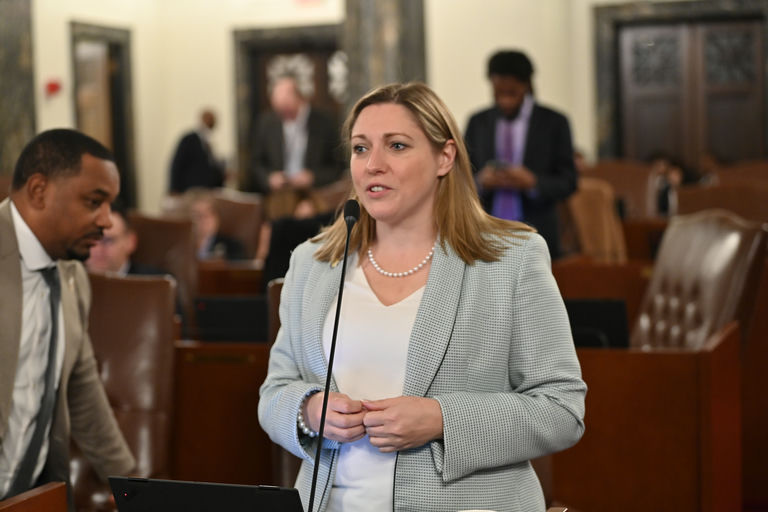
 SPRINGFIELD — Recognizing residents’ need for reliable, high-speed internet access – especially for active participation in today’s society – State Senator Rachel Ventura introduced two new measures that would expand on and protect broadband access for Illinoisans.
“Investments in broadband are essential for all Illinoisans, regardless of whether they live in a rural, suburban or urban community,” said Ventura (D-Joliet). “We’ve entered a new age where broadband is no longer a luxury, but an essential amenity, driving economic activity, improving education, expanding health care access and enhancing public services for all.”
Senate Bill 3612 would bring Illinois’ broadband protections up to par with other states in the nation, addressing minimum broadband speeds and maximum prices for low-income consumers. Specifically, the measure would require a minimum broadband download speed of 25 megabits per second for no more than $15 per month and $20 per month for high-speed service of at least 200 megabits per second, including all recurring taxes and equipment fees. Through the measure, Ventura aims to ensure access to essential amenities and educational or career opportunities never becomes a financial burden for those most in need.
The high cost of internet service is one of the main reasons Illinoisans can’t get and stay online,” said Drew Garner, director of Policy Engagement for the Benton Institute of Broadband and Society. “Surveys show that 17 percent of residents—millions of people—struggle to pay their monthly internet bills or cut service because it is too expensive. Without internet service, families lose access to education, healthcare, jobs, entrepreneurship, public services, their community, and all the innovative technologies connectivity enables. Not only does this hurt individuals, it makes Illinois less resilient, efficient, and economically dynamic. Internet service is essential for modern life, so we should make sure everyone can afford it.”
To bridge the digital divide among residents, Ventura also introduced Senate Bill 3613, which would empower local electric and telephone cooperatives to conduct their own market analyses and build networks.
Many states are fostering broadband competition by allowing more local competition with the national providers. Notable examples include Minnesota and Colorado, which provide grants and funding to support cooperative-led fiber networks, and North Carolina, Indiana, Georgia, Maryland, Texas, and Tennessee, which have clarified legal and regulatory frameworks to enable co-ops to offer broadband services. This approach allows communities to develop locally tailored solutions, with research and case studies from organizations like the Institute for Local Self-Reliance and America's Electric Cooperatives documenting these efforts. Overall, the trend emphasizes state support for community-driven broadband expansion through co-op initiatives.
"Having fast, reliable and affordable broadband is a necessity that should be accessible to everyone,” said Janie Dunning, coordinator for Show Me Broadband. “Affordability remains the number one reason why Americans lack this essential service and many are having to choose between having internet, paying their rent, buying food or taking care of their medical needs. This is unacceptable and states are going to have to take broadband affordability into their own hands."